

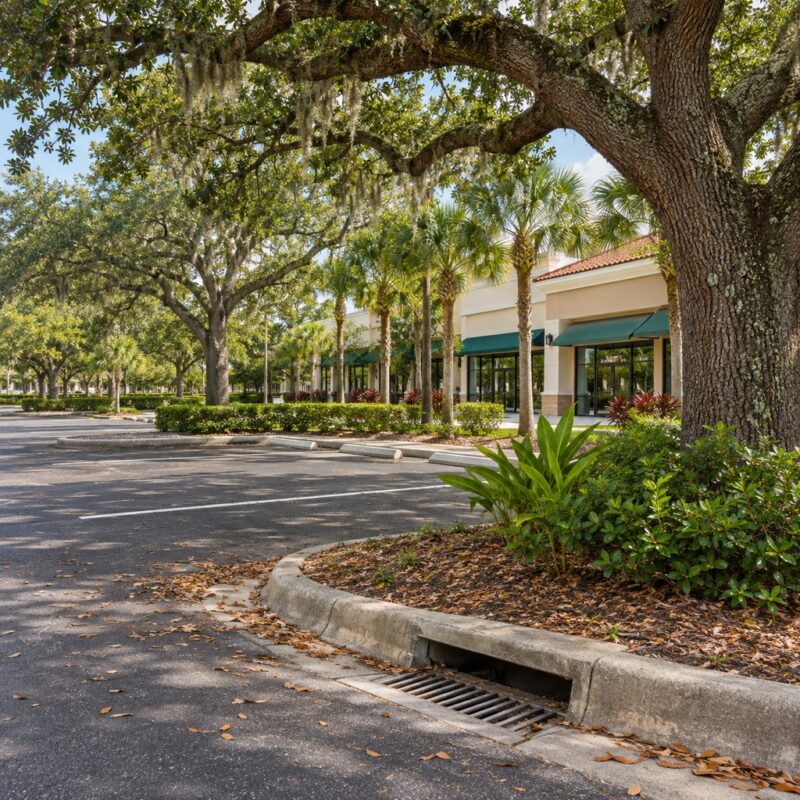
Leaf sweeping at a Tampa Bay commercial site should address the leaves actually reaching the pavement, wherever they come from and whenever they collect. A regional fall checklist is useful only if it matches the property’s trees, landscaping, and operating schedule. Start at the boundary between planting areas and paved surfaces, then follow the material toward entrances, parking spaces, and drains.
That approach makes leaf sweeping a defined maintenance task rather than a request to make the property look better. It also helps a manager explain which areas need equipment access, which need hand attention, and which may belong to a separate landscape or bulk-removal work order.
Walk the landscape edge before leaf sweeping
Inspect the perimeter of parking islands and the curb beside planted areas. Look behind wheel stops and along sheltered building edges. Material can collect in places that are barely visible from the entrance drive, especially where parked vehicles make routine access difficult.
Name those areas in the request. Leaf sweeping should not depend on a crew deciding which hidden corners matter most to the manager. A marked photo can identify priority locations, known obstacles, and sections where the pavement is damaged or turning room is limited.
Distinguish ordinary leaves from large branches, palm fronds, or abandoned items. Those materials may need different handling. Describe the volume and type before service so the provider can discuss the appropriate equipment and sequence instead of encountering an unexpected removal job.
Coordinate where landscaping ends
Ask the landscape provider how it handles material from common planting areas, lawn edges, and sidewalks. Determine whether that work will move leaves onto pavement and when the final collection will occur. The manager should make sure the two scopes connect rather than leaving a gap between them.
Leaf sweeping is more useful when the collection destination is agreed in advance. Do not assume material can be pushed into a drain, left on an adjoining parcel, or added to a yard-waste pile without checking the arrangement. Mixed sweeping loads can contain litter and sediment as well as organic debris.
On a multi-tenant property, a simple responsibility map can help. Mark the areas handled by the association or owner, the spaces maintained by tenants, and the common routes included in the provider’s work. Confirm authority to access each section before booking a visit.
Treat surface drains as inspection points
Look at the pavement immediately approaching visible inlets. Accumulated leaves can interrupt incoming water and indicate where the property needs more frequent observation. Pinellas County’s flood information guidance explains that landscape debris can block stormwater infrastructure and contribute nutrients to waterways.
Leaf sweeping can collect material at the surface, but it is not an inspection of the underground drainage system. If water remains after visible debris is removed, report the condition for further assessment. Do not promise that a cleaner grate will resolve every source of ponding.
Keep the requested task within the provider’s scope. Opening drainage structures, entering them, or repairing a damaged inlet is different work from cleaning the pavement around them. A clear distinction helps the manager arrange the right response without delaying ordinary surface collection.
Protect the route people actually use
A commercial property’s most important path may be a short stretch between parking and a doorway. Review that route from the pedestrian’s perspective. Note curb transitions, sidewalk edges, entrance corners, and the areas where people step out of vehicles.
For leaf sweeping, ask what treatment is included for places equipment cannot reach. A narrow walkway or space behind a wheel stop may require an additional method. Confirm those details instead of assuming that a parking-lot visit includes every exterior surface.
Consider a mixed office and retail site with landscaped islands and a rear service drive. The initial scope might prioritize accessible island curbs, entrance approaches, and the rear drainage route. Separately identifying these areas makes the request easier to price, schedule, and review than a broad instruction to clean everything.
Give vehicles and deliveries a plan
Tell the provider when parking rows can be made available and whether any vehicles remain overnight. Coordinate with tenant deliveries, waste collection, and other exterior contractors. Include gate instructions and one contact who can answer questions during the service window.
Leaf sweeping may be arranged in stages if the property cannot empty all at once. Give occupants a clear notice naming the affected section and the alternate arrangement. Preserve required pedestrian and vehicle access through an appropriate site plan, and communicate promptly if conditions change the visit.
Ask how obstructed areas will be documented. That record lets the manager distinguish a section that was blocked from one that was included and completed. It also provides a fair basis for discussing any return visit.
Check the result against the starting request
After leaf sweeping, revisit the priority points on the marked site photo. Look at the agreed curb lines, entrance edges, and surface-drain approaches. Record larger debris or maintenance concerns that remain outside the scope.
A practical service record should identify:
- The areas included and the date of service.
- Parking or access restrictions encountered.
- Material requiring separate collection.
- Drainage observations needing further assessment.
- Photographs from the original inspection locations.
Use the next site walk to decide whether the interval still fits. Different trees and property edges may need attention at different times. New leaf fall is not evidence that a previous visit failed; it is information for the next leaf sweeping decision.
Connect the work with Griffin’s services
Griffin Parking Area Maintenance provides power sweeping and exterior property services in the Tampa Bay region. Share the site’s landscape responsibilities, priority areas, and access restrictions when discussing the work.
For leaf sweeping that fits your commercial property, contact Griffin Parking Area Maintenance. Bring current photographs and a clear description of where material collects. That gives the team a practical starting point for a site-specific maintenance plan.